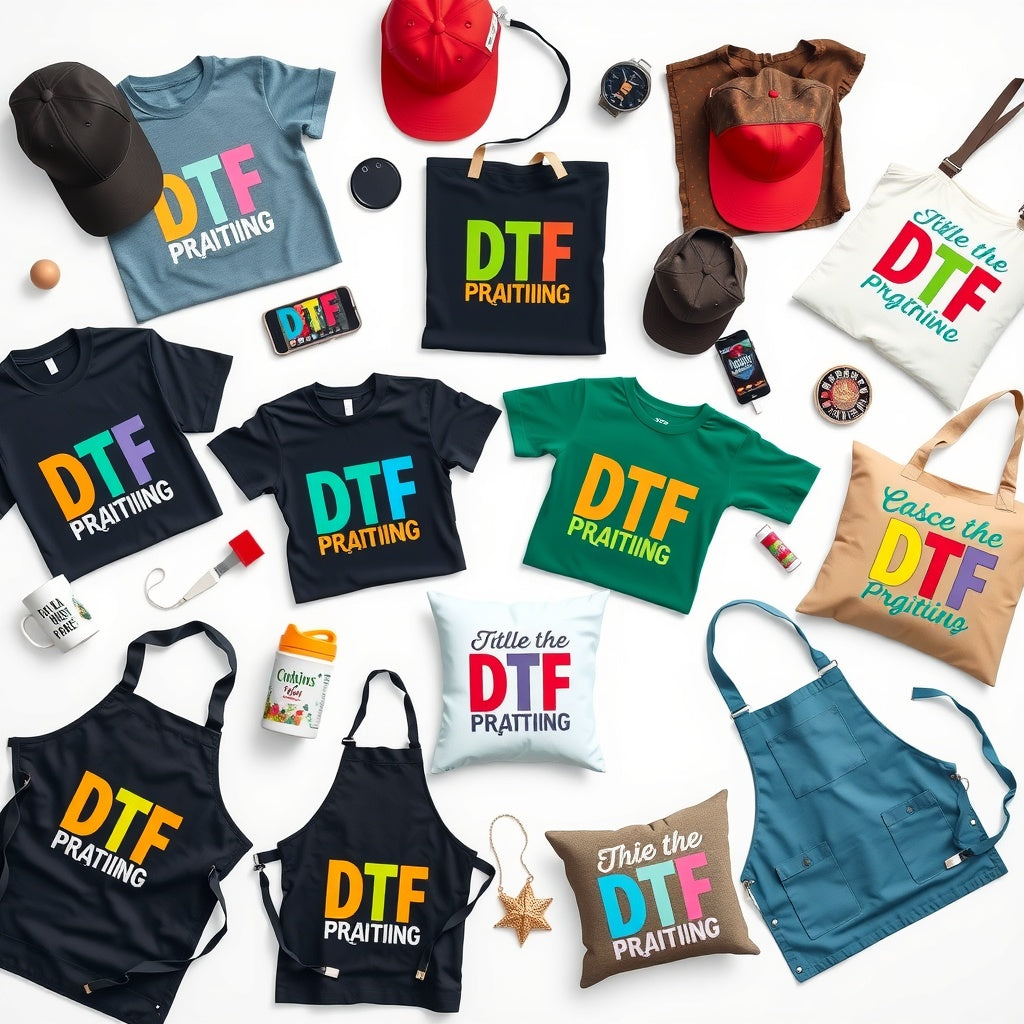
10 Custom Products to Test With DTF Transfers
DTF transfers can support more than standard T-shirts, but every product category has different materials, shapes, seams, coatings, heat limits, and economics. Treat each idea below as a product to test, not as a guaranteed high-margin item.
1. Graphic T-shirts
T-shirts are a straightforward starting point because many provide a large flat print area and familiar sizing. Compare the exact blank style, color, fabric, measurements, artwork size, transfer compatibility, and application process before selling it broadly.
2. Hoodies and sweatshirts
Hoodies can support front, back, sleeve, or smaller chest designs, but pockets, zippers, seams, hoods, fleece texture, and fabric blends affect the printable area. Measure the exact garment and test around thick construction.
3. Tote bags and canvas products
Totes can provide a flat decoration panel, but gussets, handles, coatings, seams, pockets, and material composition vary widely. Measure the usable panel and test the transfer on the exact bag.
4. Baby and kids apparel
Infant bodysuits and youth shirts need smaller artwork, careful placement around snaps and seams, garment-specific application testing, and attention to any children's-product requirements that apply to what you sell. Do not make blanket safety or compliance claims without documentation.
5. Caps and hats
Curved surfaces are different from a flat shirt platen. Use DTF on a cap only when the transfer, cap material, and equipment are designed for that workflow. Structured seams, panels, bills, coatings, and curved pressure make testing essential.
6. Aprons
Aprons can work when the front panel is compatible and lies flat. Check pockets, straps, coatings, stain-resistant finishes, and fabric heat tolerance before applying a transfer.
7. Pillow covers and fabric home textiles
Removable fabric covers can provide a useful flat area, but identify the material, coatings, zipper location, seams, and care requirements. Do not assume every upholstery or decorative textile can tolerate a heat-press process.
8. Sports and performance apparel
Polyester and performance fabrics may be heat-sensitive or vulnerable to dye migration. Sublimated jerseys, mesh panels, stretch zones, and moisture-management finishes require special attention. Use an appropriate transfer and test the exact garment.
9. Pet bandanas and fabric pet accessories
Decorate only products whose material and construction support the process. Keep the decoration away from hardware, fasteners, heavy seams, and areas that could be chewed or create a hazard if the product is damaged. Product safety depends on the complete finished item, not the decoration method alone.
10. Small fabric accessories
Pouches, fabric patches, headbands, reusable bags, and similar items may be candidates when they offer a stable flat area and compatible material. Their small dimensions make precise artwork sizing and equipment access especially important.
How to decide whether a product is worth testing
Ask:
- Can the product lie flat enough for the required application?
- Can the material tolerate the transfer-specific process?
- Are coatings, seams, zippers, hardware, or stretch zones in the way?
- Can you source the product consistently?
- Does the finished item meet the quality and safety requirements of the intended use?
- Can you sell it at a price that covers the complete cost?
Calculate profit from current costs
Use actual numbers for blank product, transfer, inbound freight, application labor, packaging, payment fees, outbound shipping contribution, errors/reprints, customer acquisition when applicable, and overhead. Then subtract the full cost from the selling price. Do not assume a product category has a fixed 70%, 80%, or other margin.
Gang sheets and product mix
Gang sheets can be useful when several transfers fit efficiently on one current sheet size. Calculate the actual sheet price, transfer dimensions, cutting/sorting labor, and quantities. There is no guaranteed number of transfers per sheet or universal savings percentage.
Test before listing
Produce the exact product you intend to sell. Inspect artwork, application, surface condition, normal movement/use, and care performance. Photograph the real result when possible.
Do not promise universal compatibility
A DTF transfer that works on one cotton tee does not prove compatibility with a nylon cap, coated tote, sublimated jersey, or rayon garment. Follow the transfer documentation and product heat limits for every new category.
Common questions
Which DTF product is most profitable?
No product category has a guaranteed margin. Profit depends on your current input costs, labor, pricing, returns, shipping, and customer acquisition.
Do I need a different transfer for every product?
Possibly. Transfer requirements can vary by material and application. Confirm compatibility with the supplier rather than assuming one transfer works on every textile.
Can I use DTF on hats?
Only when the cap material, transfer, and curved application equipment support that workflow. Test the exact product.
How much money do I need to start?
Build the budget from the products, samples, transfers, blanks, equipment, packaging, store, and operating costs you actually plan to use. There is no universal startup amount.
Check DTF fabric compatibility · Read application guidance · Review custom DTF transfer options
InkMerge Pro
Need the transfer, not the shirt?
Browse ready-to-press DTF designs or upload your own artwork. Current product pricing and shipping details are shown on the product page and at checkout.