How to Size DTF Designs for Different Garment Sizes
Correct transfer sizing separates professional-looking garments from amateur ones. A design sized for adult XL will overwhelm a youth medium. A left chest logo sized for men's shirts sits too low on women's cuts.
This guide provides exact DTF transfer dimensions for every common garment type, size, and placement.
Standard Adult T-Shirt Sizing
Full Front Center Print
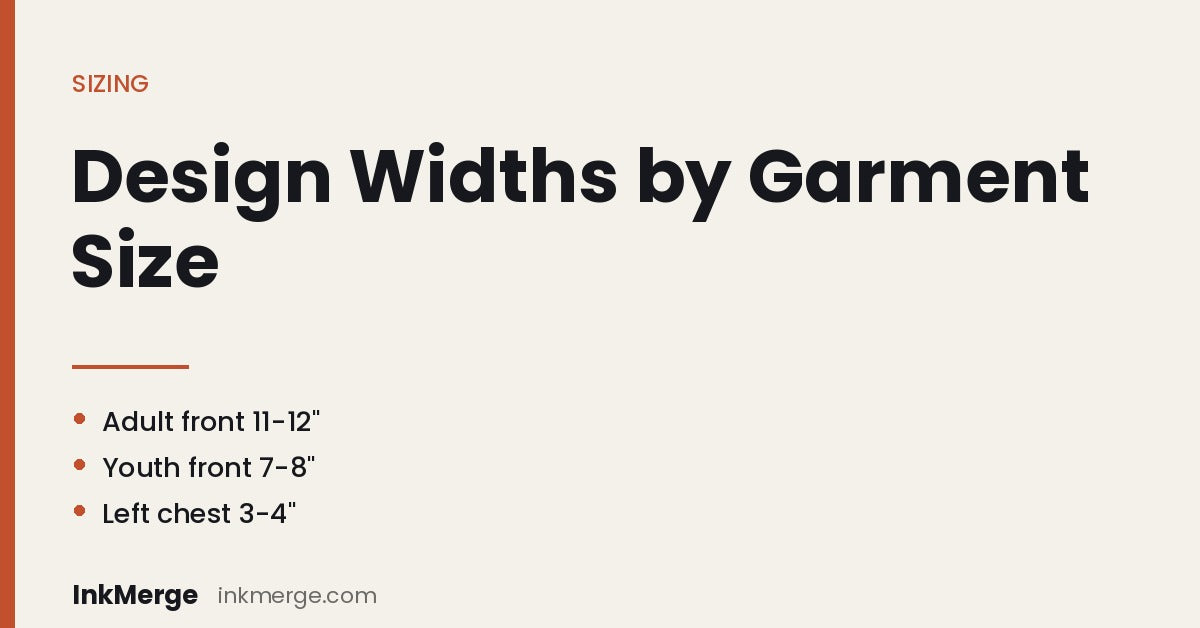
- Small/Medium: 10" x 12" maximum
- Large/XL: 11" x 14" maximum
- 2XL/3XL: 12" x 14" maximum
- Placement: Center horizontally. Top of design 3-4" below neckline seam
Left Chest (Pocket Position)
- All adult sizes: 3.5" x 3.5" to 4" x 4"
- Placement: 7-9" down from left shoulder seam, 4-5" in from left side seam
Full Back Print
- S/M: 10" x 12" | L and above: 12" x 14"
- Placement: Center horizontally, top 3-4" below back neckline
Oversized/Streetwear
- All sizes: 14" x 17" maximum on oversized blanks
- Intentionally fills most of the front panel — popular in streetwear
Youth and Kids Sizing
Youth T-Shirts (Ages 6-14)
- Front center (YS-YM): 7" x 9"
- Front center (YL-YXL): 8" x 10"
- Left chest: 3" x 3"
- Back: 8" x 10"
Toddler (2T-5T)
- Front center: 5" x 6" to 6" x 7"
- Left chest: 2" x 2" to 2.5" x 2.5"
Infant Onesies (0-24 months)
- Front center: 4" x 5" maximum
- Account for snap closures at bottom — keep designs in upper chest area
Hoodie and Sweatshirt Sizing
- Front center (S-M): 10" x 10" — shorter height due to kangaroo pocket
- Front center (L-3XL): 11" x 12"
- Left chest: 3.5" x 3.5"
- Back (below hood): 12" x 14" — position top 5-6" below hood seam
- Hood: 5" x 4" — account for center seam
Specialty Items
Tote Bags
- Standard (15" x 16"): 10" x 10" to 12" x 12" design area
- Small (13" x 13"): 8" x 8" to 10" x 10"
Hats and Caps
- Front panel: 4" x 2.5" maximum for structured caps
- Side panel: 2" x 2" to 3" x 2"
Sleeves
- Upper sleeve: 3.5" x 4" to 4.5" x 5"
- Full sleeve run: 3" x 12" (vertical text or pattern)
- Placement: Center on outer sleeve, 1-2" below shoulder seam
Women's Fitted Shirts
Women's cuts run narrower and shorter than unisex. Reduce dimensions by 15-20%:
- Front center (S-M): 8" x 10"
- Front center (L-XL): 9" x 11"
- Left chest: 3" x 3" to 3.5" x 3.5"
- V-neck adjustment: Start design 4-5" below neckline to avoid the V opening
How to Measure Placement on the Garment
- Lay flat on heat press or table, front up, smoothed with no wrinkles
- Find center: Fold shirt at shoulder seams — the fold line is horizontal center
- Measure down from neckline seam (not collar) to set vertical position
- Center the transfer on the center line at your measured starting point
- For left chest: 4" in from left side, 3.5" down from left shoulder seam
One Size vs. Size-Specific Transfers
Option 1: One Size Fits Most
Use a medium-range size (10" x 12") across all adult sizes. Looks slightly smaller on 2XL-3XL, slightly larger on S. Acceptable for most applications and simplifies ordering.
Option 2: Size-Specific Transfers
Understanding Garment Fit and Cut Differences
Garment sizing is not standardized. The same 'Large' from different manufacturers has different dimensions. This is critical for transfer sizing.
Unisex Cut (Gildan, Fruit of the Loom, Standard Blanks)
Unisex cuts are designed to fit a wide range of body types. The fit is roomier and taller than fitted cuts. A unisex Large is about the same width as a women's XL but longer.
- Front chest width: 20.5"
- Shoulder-to-hem length: 28"
- Sleeve length: 8.5"
Women's Fitted Cut (Anvil, Bella Canvas, Fitted Shirts)
Women's cuts taper at the waist and neck. The same size Large is noticeably narrower and shorter than unisex.
- Front chest width: 18"
- Shoulder-to-hem length: 26"
- Sleeve length: 7.5"
Men's Fitted Cut (American Apparel, Premium Fitted)
Men's fitted cuts are roomier than women's but slimmer than unisex. Popular for streetwear and fashion brands.
- Front chest width: 19.5"
- Shoulder-to-hem length: 28"
- Sleeve length: 8.75"
Practical implication: A 10" × 12" design looks proportionally smaller on a women's fitted shirt than on an unisex shirt of the same labeled size. If you sell across fit types, consider creating two design variants.
Placement Positioning: The Science of Where to Position Transfers
Placement is not arbitrary—it is determined by garment anatomy and eye-line.
Center Finding Method
For perfectly centered designs:
- Lay the garment flat on the heat press, completely smooth
- Fold the neckline down to the hem and crease with your hand
- Fold the left shoulder seam to the right shoulder seam
- The intersection of these two folds is the absolute center of the garment front
- Unfold and mark this center point with a tape marker (removable, not permanent)
This method accounts for asymmetrical printing, pocket placement, and garment quirks. It is more accurate than visual estimation.
Vertical Placement Standards
The distance from neckline to design top varies by design size and audience:
- Youth and children: 2.5-3" from neckline (designs higher, relative to shorter torsos)
- Adult standard: 3-4" from neckline (eye-level when looking at the wearer)
- Oversized/streetwear: 2-3" from neckline (design fills more vertical space, so starts higher)
- V-neck or low-cut: 5-6" from neckline (avoids the V opening)
- Pocket position (left chest): 8-9" down from left shoulder seam, 4-5" in from left side seam (mimics natural pocket placement)
These are not hard rules—they are industry standards. Different brands and subcultures have different conventions. When in doubt, place slightly higher rather than lower. High placement appears more intentional; low placement can appear accidental.
Back Print Placement
Back placement uses identical measurements: 3-4" below the back neckline, centered horizontally. However, back prints appear higher due to perspective when viewing a person standing. Account for this in design sizing—a 12" × 14" front print may appear too large as a back print. Consider reducing to 11" × 13".
Advanced Sizing Strategies for Multiple Garment Types
When you sell across multiple garment types (t-shirts, hoodies, tote bags, hats), sizing strategy becomes complex. Here are approaches successful businesses use.
Strategy 1: One-Size-Fits-All (Simplest)
Create designs at a medium size (11" × 13" for front prints) that works acceptably across adult sizes. Looks slightly small on 3XL, slightly large on S, but professional overall.
Advantage: Single design file, lowest cost
Disadvantage: Suboptimal fit on extreme sizes
Best for: Businesses with limited design volume or small customer base
Strategy 2: Size-Specific Variants (Professional)
Create two or three file variants:
- Small variant (S-M): 9" × 11"
- Standard variant (L-XL): 11" × 13"
- Large variant (2XL-3XL): 12" × 14"
When customer orders, they specify size. You apply the appropriate variant.
Advantage: Optimal proportions for each size, professional appearance
Disadvantage: Three files per design, slightly higher inventory management
Best for: Premium brands, larger order volumes
Strategy 3: Scalable Designs with Safe Margins
Design with generous margins so the same file scales 10-20% up or down without compromising aesthetics. Use gang sheets to print the same design at multiple scales on one sheet.
Advantage: Flexible, minimal file management
Disadvantage: Requires careful design planning, may not work for all design types
Best for: Logo-heavy designs, text-based designs
Managing Product-Specific Sizing
For specialty items:
- Hoodies vs t-shirts: Same front design, 5-10% smaller for hoodies (shorter front panel due to kangaroo pocket)
- Long-sleeve vs short-sleeve: Identical front sizing, but account for longer sleeve length in sleeve-placement calculations
- Tank tops: 10% wider than t-shirts (lower armhole, wider coverage), same vertical distance from neckline
- Tote bags: Designs 15-20% smaller than apparel. The canvas is flat and direct, unlike fabric that curves on a body
- Hats and caps: Front panel is 4-5" wide by 2.5-3" tall. Any design larger must wrap around the cap, which is complex. Keep designs simple and compact
Document these standards and create a sizing reference guide for your team. Consistency across products builds trust with customers.
Sizing for Special Occasions and Niche Garments
Beyond standard t-shirts, DTF opens doors to specialized product categories with unique sizing needs.
Baby and Maternity Wear
- Infant bodysuits (0-3 months): Front design 3" x 4" maximum. Position in upper chest area, avoiding snap closures at bottom
- Baby t-shirts (6-24 months): 4" x 5" to 5" x 6" front center. Shorter width due to small torso
- Maternity tanks/shirts (second/third trimester): Design should be wider and lower than standard sizing. Accommodate the larger belly—place design 4-5" down from neckline rather than 3"
Pro tip: Maternity customers often want designs that celebrate pregnancy (belly graphics, cute illustrations on the belly area). This is the one case where "low placement" is intentional and desired.
Sports Performance Wear
Athletic garments have unique properties that affect sizing:
- Compression shirts/base layers: Design 10% smaller than equivalent t-shirt size due to tight fit. A standard 11" x 13" front is too large; reduce to 10" x 11"
- Soccer/sport jerseys: Numbers and names on back typically 4-6" tall. Ensure numbers fit within shoulder blades without extending to sides/sleeves. Test on a mock-up before ordering
- Running bibs: Design area is 6" wide x 8" tall maximum. Keep simple and bold—runners read it while moving
- Leggings/tights: Side leg placement: 2.5" x 4" design positioned 2-3" above ankle, running vertically
Important: Some athletic fabrics have directional stretch (more stretch in one direction). Verify your design works when the garment is stretched. Elastic recovery should bring the design back to normal when relaxed, but distortion during wear is noticeable.
Oversized Fashion and Streetwear
Oversized fashion demands larger, bolder designs:
- Oversized t-shirt (intentional): 13" x 16" to 15" x 18" front print. Design fills most of the front panel intentionally
- Oversized hoodies/sweatshirts: 12" x 15" to 14" x 17" front. Hood placement: 5-6" below back neckline to sit below the hood
- Boxy fit shirt: 12" x 14" front center. These run wider, so designs appear less oversized on actual garment
- Streetwear all-over print: Multiple 6" x 8" designs scattered across front, or wraparound designs extending from front to side seams
Test oversized designs carefully. A 15" x 18" design on a standard adult large may look disproportionate. Order a single sample on the actual blank before committing to production quantities.
Vintage and Retro-Style Apparel
Retro designs have specific conventions for authenticity:
- 70s-80s band tees (emulation): 10" x 12" front, centered. Slightly worn/faded aesthetic preferred (adjust DTF colors to muted, less saturated versions)
- Vintage logo styling: 3-4" left chest placement for small, classic logos
- Large graphic back prints: 11" x 14" back print, positioned higher (2.5" below neckline) to match era-appropriate placement
Retro buyers are often nostalgic for genuine vintage pieces. The sizing convention of slightly smaller-than-modern placements adds to authenticity. When marketing vintage-style designs, call out "authentic sizing inspired by original 1980s apparel" as a selling point.
Plus-Size Specific Considerations
Plus-size garments (3XL and above) are cut differently and require adjusted sizing:
- Full front print (3XL+): 13" x 15" to 14" x 16" (same rule: 10% larger than standard for proportional fit)
- Left chest on plus-size: 4" x 4" (slightly larger than standard 3.5" x 3.5" due to larger overall proportions)
- Back prints: 13" x 15" (plus-size backs are notably wider)
Dress and Skirt Placement
Dresses and skirts have less usable design area than shirts:
- Maxi dress front: 10" x 12" centered, positioned 4-5" below shoulder to leave bust/waist area visible
- Mini dress front: 8" x 10" (narrower due to shorter garment length)
- Pencil skirt side placement: 4" x 6" design on outer thigh area (not front waist, which would distort with sitting)
- A-line skirt: 8" x 8" front center placement (has more usable width than fitted skirts)
Design placement on dresses is less forgiving than on t-shirts. Test on an actual garment in the intended size before ordering large quantities.
Frequently Asked Questions
What if my design does not fit standard dimensions?
Resize proportionally (maintain aspect ratio) to fit within recommended dimensions. Keep at least 1" from garment side seams.
Does sizing differ for dark vs light garments?
No. DTF transfer sizing is identical regardless of garment color. The white underbase layer ensures consistent appearance on both.
How do I handle text on small garments?
Test readability at target print size before ordering. Text below 8pt at print size may be difficult to read. For youth/toddler, simplify design or increase font size. Best fonts for t-shirts.
How do I account for how the garment shrinks after first wash?
Most quality blank garments shrink less than 5% after one wash, then stabilize. Size your designs for post-shrink dimensions. If a shirt shrinks from 21" wide to 20" wide, a 10" design goes from 48% of width to 50% of width—a negligible difference.
What is the smallest readable text size for DTF transfers?
Text below 8 point at actual print size becomes difficult to read, especially thin fonts. For best results on garments, use 12pt minimum for body text, 14pt+ for headlines. Test with a sample before committing to large orders.
Do I size the same for light vs dark garments?
No sizing difference. The white underbase ensures the same visual size regardless of garment color. Dark fabrics show the full design edge more clearly because of contrast, but physical dimensions are identical.
How do I handle custom sizing requests from customers?
Have clear policy: standard sizes available at standard pricing, custom sizing available at +20-30% premium for file modification time. Most customers accept standard sizes; premium customers pay the modification fee.
Should I size differently for printing vs embroidery comparison?
Yes. Embroidery becomes illegible below 0.5 inches wide; DTF maintains quality down to 0.25 inches. DTF gives you flexibility for smaller, more detailed designs.
What if a customer asks to enlarge a design beyond recommended size?
Advise against it but permit the request at their risk. Oversized designs look distorted on garments and exceed armhole or shoulder seams. Document the customer's explicit request in writing to avoid disputes.