DTF Printing Guides T-Shirt Printing Methods Explained: Complete Guide to Choosing the Best Method in 2026

T-Shirt Printing Methods Explained: Complete Guide to Choosing the Best Method in 2026

T-Shirt Printing Methods Explained: Complete Guide to Choosing the Best Method in 2026

Choosing the right t-shirt printing method can make or break your custom apparel project. Whether you are launching a t-shirt business, creating team uniforms, or making personalized gifts, the printing technique you select determines your print quality, durability, cost per shirt, and overall satisfaction with the final product.

With so many different t-shirt printing methods available today, it is easy to feel overwhelmed. From traditional screen printing to modern DTF (Direct to Film) printing, each method has distinct advantages depending on your design complexity, order size, fabric type, and budget. This comprehensive guide breaks down every major type of t-shirt printing so you can decide which t-shirt printing method is best for your specific needs.

At InkMerge, we specialize in custom DTF transfers that work with virtually any fabric and require no minimum orders — but we believe in helping you understand all your printing options before making a decision. Let us walk you through every popular t-shirt printing technique used in the industry today.

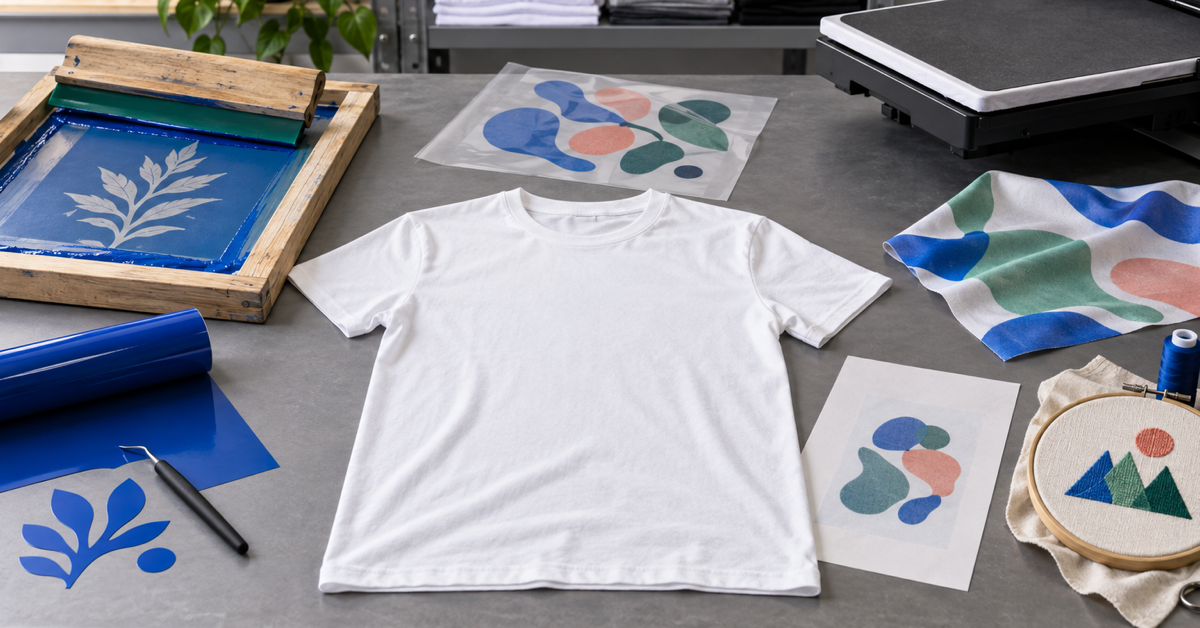
Various t-shirt printing methods displayed in a modern custom apparel printing workspace with heat press and colorful custom t-shirts

What Are the Different T-Shirt Printing Methods?

The t-shirt printing industry offers a wide range of methods, each suited to different types of projects. Understanding these different printing methods is essential before committing time and money to a specific approach. Some methods like screen printing work best for large bulk orders, while others like DTF printing excel at small runs with complex, full-color designs.

Overview of Common T-Shirt Printing Methods

The most common t-shirt printing methods include screen printing, direct-to-garment (DTG) printing, DTF (Direct to Film) printing, sublimation printing, heat transfer vinyl (HTV), heat transfer printing, all-over print techniques, and discharge printing. Each printing process uses different technology to apply ink or transfer material onto the fabric, resulting in different levels of quality, durability, and cost.

Modern advances have dramatically expanded the printing options available to both businesses and hobbyists. Methods like DTG and DTF printing are relatively new additions to the industry, offering digital precision that was impossible just a decade ago.

How to Choose the Right Printing Technique

The best t-shirt printing method for your project depends on several factors: your order quantity, design complexity, the fabric type of your garments, your budget, and your desired turnaround time. A suitable printing technique for a 500-piece order of single-color team shirts is very different from what works best for a 10-piece run of photorealistic custom t-shirts.

Throughout this guide, we will help you decide which t-shirt printing method matches your specific requirements by comparing cost, quality, durability, and ease of use for each technique.

Screen Printing: The Industry Standard

Screen printing is the most widely recognized t-shirt printing method and remains the backbone of the custom apparel industry. Also known as silkscreen printing, this technique has been used for decades and continues to dominate high-volume production. Screen printing remains the go-to choice for brands, sports teams, and promotional products that require large quantities of consistent, high-quality prints.

How Screen Printing Works

Screen printing works by pushing ink through a mesh stencil (or screen) directly onto the fabric. Each color in the design requires a separate screen, making setup more complex for multi-color artwork. The ink is pressed onto the t-shirt using a squeegee, then cured with heat to create a durable bond.

Traditional screen printing uses plastisol or water-based inks. Plastisol inks sit on top of the fabric and produce vibrant, opaque colors. Water-based inks absorb into the fabric for a softer hand feel. Screen printing is ideal for designs with limited colors and bold graphics.

Pros and Cons of Screen Printing

Screen printing offers exceptional durability and vibrant colors, especially for simple designs. The cost per shirt decreases dramatically with larger orders, making it the most economical choice for printing in bulk. Screen printing also works on a wide range of fabric types including cotton t-shirts, polyester blends, and synthetic fabrics.

However, screen printing has significant drawbacks for small orders. Setup costs are high because each color requires a separate screen. Photorealistic or gradient designs are difficult to achieve. Screen printing works best for simpler designs with fewer colors and larger order quantities — typically 50 pieces or more to justify the setup investment.

Best Use Cases for Screen Printing

Screen printing is best suited for bulk orders of 50+ shirts with designs containing 1-6 colors. It excels for sports teams, corporate events, band merchandise, school spirit wear, and promotional giveaways. If you need hundreds or thousands of identical shirts, screen printing offers the lowest cost per unit of any printing method.

DTF Printing: The Modern Game-Changer

DTF printing (Direct to Film) has rapidly become one of the most popular t-shirt printing techniques in the industry. Unlike screen printing, DTF printing is a digital process that requires no screens, no minimum orders, and no pre-treatment of garments. This modern printing method is revolutionizing how custom apparel is produced, especially for small businesses and entrepreneurs.

How DTF Printing Works

DTF printing involves printing a design onto a special PET film using CMYK plus white ink. A hot-melt adhesive powder is then applied to the wet print and cured. The resulting transfer is pressed onto the fabric using a heat press, where the design is printed onto the garment with vibrant, full-color detail.

What makes DTF unique is that the transfer can be applied to virtually any fabric type — cotton, polyester, synthetic fabrics, blends, and even challenging materials like nylon. The adhesive powder creates a strong bond regardless of the substrate, unlike methods like sublimation printing that only work on polyester.

Why DTF Is Gaining Popularity

DTF printing produces photorealistic, full-color prints with no color limitations. There are no screen setup costs, so it is equally affordable whether you are printing one shirt or one hundred. The design complexity does not affect the price — a simple logo costs the same as a detailed photograph.

For entrepreneurs starting a t-shirt business, DTF transfers offer incredible flexibility. With services like InkMerge's custom DTF transfers, you can order transfers at just $0.02 per square inch with free shipping on orders over $99 and 24-48 hour turnaround — no equipment investment required. Simply press them onto your garments with a heat press and you are ready to sell.

DTF vs Screen Printing: Key Differences

While screen printing excels at high-volume runs with simple designs, DTF printing dominates in versatility and small-batch economics. Screen printing to DTF represents a major shift in the industry, with many print shops adding DTF capability to complement their existing screen printing operations.

DTF prints have excellent wash durability, vivid colors, and a slightly raised feel on the garment. Unlike screen printing, there is no limit on the number of colors, and photorealistic images look stunning. For orders under 50 pieces, DTF is almost always more cost-effective than screen printing.

DTG Printing: Direct-to-Garment Digital Printing

Direct-to-garment printing, commonly known as DTG printing, is another digital t-shirt printing method that prints ink directly onto the fabric using specialized inkjet technology. DTG printing has been a popular choice for print on demand services and custom one-off orders since the mid-2000s.

How DTG Printing Works

DTG printing uses modified inkjet printers that spray water-based ink directly onto the t-shirt. The garment is pre-treated with a special solution (especially for dark fabrics), loaded onto the printer platen, and the design is printed directly onto the fabric. The print is then heat-cured to set the ink.

Because DTG printing works like a standard inkjet printer, it can produce unlimited colors and photorealistic detail. Methods like DTG printing excel at complex artwork and photograph reproduction. The ink absorbs into the fabric, giving prints a soft hand feel that many consumers prefer.

DTG Printing Advantages and Limitations

DTG printing produces excellent print quality with a soft feel since the ink integrates with the fabric fibers. It requires no screen setup, making it ideal for small quantities and print on demand businesses. Each shirt can feature a completely unique design without any additional cost.

However, DTG printing has notable limitations. It works best on 100% cotton t-shirts and struggles with synthetic fabrics and polyester blends. Pre-treatment adds time and cost, especially for dark garments. DTG printers are expensive to purchase and maintain, and print speeds are relatively slow compared to screen printing or DTF methods.

DTG vs DTF: Which Digital Method Is Better?

Both DTG and DTF are digital printing methods, but they differ significantly in fabric compatibility, feel, and production workflow. DTG printing produces softer prints that breathe with the fabric, while DTF creates more vibrant, opaque transfers that work on any material.

DTG and screen printing have different ideal use cases, but when comparing digital methods, DTF often wins on versatility. DTF transfers can be prepared in advance and stored, while DTG requires the actual garment to be loaded into the printer. For businesses that need to print on varied fabric types, DTF is the more flexible printing method.

Sublimation Printing: Vibrant Colors for Polyester

Sublimation printing is a unique heat transfer printing method that uses heat and pressure to convert solid dye into gas, which then bonds permanently with polyester fibers. This printing technique produces incredibly vibrant, all-over prints that will never crack, peel, or fade because the dye becomes part of the fabric itself.

How Sublimation Printing Works

In sublimation printing, a design is printed onto special sublimation paper using sublimation inks. When heat and pressure are applied via a heat press, the inks transform from a solid state directly into gas (a process called sublimation), bypassing the liquid state entirely. The gas penetrates the polyester fibers and returns to a solid state, permanently embedding the color in the design.

This printing process produces prints that are virtually part of the fabric — you cannot feel the print on the surface. Colors are extremely vibrant and the design is printed with sharp detail.

Sublimation Printing Limitations

The biggest limitation of sublimation printing is that it only works on polyester or polymer-coated substrates. It does not work on cotton t-shirts or natural fiber fabrics. Sublimation also requires white or very light-colored garments, as there is no white ink — the fabric color shows through.

Despite these restrictions, sublimation printing is perfect for all-over print designs on performance athletic wear, jerseys, and custom polyester apparel. If your project involves synthetic fabrics and you want edge-to-edge coverage, sublimation is an excellent type of t-shirt printing to consider.

Heat Transfer Vinyl (HTV): Cut and Press Simplicity

Heat transfer vinyl printing, commonly called HTV, is one of the most accessible t-shirt printing methods for beginners and small operations. Vinyl printing involves cutting designs from sheets of colored vinyl using a cutting machine, then pressing the cut design onto the fabric with a heat press.

How Vinyl Printing Works

Vinyl printing starts with a digital design that is sent to a vinyl cutter (like a Cricut or Silhouette machine). The cutter traces the design outlines on a sheet of heat transfer vinyl. After weeding (removing the excess vinyl), the remaining design is positioned on the garment and heat pressed onto the t-shirt.

The heat activates an adhesive on the back of the vinyl, bonding it permanently to the fabric. HTV comes in a wide range of colors, finishes (matte, glossy, glitter, metallic, holographic), and specialty types. Printing involves cutting each color separately and layering them on the garment.

When Vinyl Printing Is the Right Choice

Vinyl printing works best for simple, bold designs with limited colors — think names, numbers, and basic logos. It excels for custom jerseys, personalized gifts, and small batches where each shirt needs different text. The startup cost is low since a basic vinyl cutter and heat press are relatively affordable.

However, vinyl printing is not suitable for complex designs, photographs, or gradients. Each color must be cut and layered separately, making multi-color designs time-consuming. For anything beyond simple text and basic graphics, other methods like DTF or DTG are more appropriate.

Heat Transfer Printing: Paper-Based Transfers

Heat transfer printing encompasses a broader category of methods where a design is first printed on paper or film, then transferred onto the fabric using heat and pressure. This includes inkjet transfers, laser transfers, plastisol transfer printing, and other paper-based approaches. This heat transfer printing method is distinct from vinyl cutting and offers different capabilities.

Types of Heat Transfer Printing

Heat transfer printing includes several sub-methods. Inkjet heat transfers use a standard inkjet printer for printing on paper coated with a special transfer layer, which is then pressed onto the shirt. Laser transfers work similarly but use a laser printer. Plastisol transfer printing uses screen printing technology to print on transfer sheets instead of printing directly onto the garment.

Each heat transfer method has different quality levels. Consumer-grade inkjet transfers from office supply stores produce decent results for occasional use. Commercial plastisol transfers and DTF transfers deliver professional-quality output suitable for retail sale.

Comparing Heat Transfer Methods

Among heat transfer printing methods, DTF transfers offer the best combination of quality, versatility, and ease of use. Traditional inkjet transfers tend to crack and fade faster, while plastisol transfers require the same screen setup as screen printing. DTF transfers deliver vibrant, durable prints without the limitations of either approach.

For anyone looking to start a heat transfer-based t-shirt business, ordering ready-to-press DTF transfers from a supplier like InkMerge eliminates the need for expensive printing equipment while still delivering professional results.

All-Over Printing: Edge-to-Edge Coverage

All-over print is a t-shirt printing technique that covers the entire garment surface with design — from seam to seam. Unlike standard chest or back prints, all-over printing creates garments where the design extends across the full shirt, including sleeves and side panels.

Methods for All-Over Printing

All-over print designs can be achieved through sublimation printing (most common for polyester), cut-and-sew methods (printing fabric before construction), and large-format DTG or DTF prints. Sublimation is the most popular method for all-over printing because the design is printed seamlessly across the entire garment.

Cut-and-sew all-over printing involves printing on flat fabric panels before they are assembled into a garment. This method produces the most professional results since every part of the shirt is covered, with no blank spots near seams.

When to Choose All-Over Printing

All-over printing is popular for fashion brands, streetwear labels, and custom athletic jerseys. It creates eye-catching, premium-looking garments that stand out from standard printed t-shirts. However, all-over printing is generally more expensive and has longer production times than standard placement prints.

Specialty Printing Techniques: Discharge, Plastisol, and More

Beyond the major printing methods, several specialty techniques serve niche applications in the t-shirt printing industry. These include discharge printing, plastisol transfer printing, and various hybrid approaches that combine multiple methods.

Discharge Printing

Discharge printing is a specialized screen printing technique that removes the existing dye from the fabric and replaces it with a new color. Instead of printing on top of the fabric, the design is printed by actually changing the fabric color itself. This produces an incredibly soft print with no hand feel at all — the design looks and feels like part of the original garment.

Discharge printing only works on natural fibers like cotton and requires dark-colored garments. It is a premium printing method favored by high-end fashion brands and concert merchandise producers.

Digital Printing and Emerging Technologies

The t-shirt printing industry continues to evolve with new digital printing technologies. Hybrid methods that combine screen printing and heat transfer techniques are gaining traction. Direct-to-garment printing equipment continues to improve in speed and quality. Sustainable ink formulations and eco-friendly printing processes are becoming more common as the industry responds to environmental concerns.

As technology advances, the lines between different printing methods continue to blur, giving businesses more printing options than ever before.

How to Choose the Best T-Shirt Printing Method for Your Project

With so many types of t-shirt printing methods available, choosing the best method for your project requires careful consideration of several factors. The printing technique depends on your specific needs, and there is no single best answer — it depends on your order size, design, fabric, and budget.

Choosing by Order Quantity

For large orders (100+ pieces) with simple designs, screen printing offers the lowest cost per shirt. For medium orders (10-100 pieces) with colorful designs, DTF printing provides the best balance of cost and quality. For single pieces or print on demand fulfillment, DTG printing or pre-made DTF transfers are ideal.

The printing method you choose should align with your production volume. Screen printing is ideal for high-volume consistency, while DTF and DTG handle variable-data and short-run production efficiently.

Choosing by Design Complexity

Simple, bold designs with 1-3 colors: screen printing or vinyl printing. Full-color photorealistic designs: DTF or DTG printing. Gradients and photographs: DTF, DTG, or sublimation. All-over patterns: sublimation or cut-and-sew. Text and names: vinyl or DTF.

Design complexity is often the deciding factor. If your design has unlimited colors, gradients, or photographic elements, digital methods like DTF printing are your best option.

Choosing by Fabric Type

Cotton t-shirts: all methods work, but DTG and screen printing excel. Polyester and synthetic fabrics: sublimation or DTF (avoid DTG). Blended fabrics: DTF or screen printing. Performance athletic wear: sublimation or DTF. Dark garments: screen printing, DTF, or vinyl.

Fabric compatibility is a critical factor. Only DTF and screen printing work well across virtually all fabric types. Sublimation printing is limited to polyester, and DTG works best on cotton. Choose the best method based on your garment material.

Frequently Asked Questions

What is the best t-shirt printing method for small businesses?

For small businesses, DTF printing is often the best t-shirt printing method because it requires no minimum orders, works on all fabric types, and produces professional-quality full-color prints. Services like InkMerge offer custom DTF transfers at just $0.02 per square inch with no minimums, making it easy to start a t-shirt business without investing in expensive equipment.

What are the different types of t-shirt printing methods?

The main types of t-shirt printing methods include screen printing, DTF (Direct to Film) printing, DTG (direct-to-garment printing), sublimation printing, heat transfer vinyl printing, heat transfer paper printing, all-over print, and discharge printing. Each method has unique advantages depending on your design complexity, order quantity, and fabric type.

Which t-shirt printing technique is most durable?

Screen printing and DTF printing offer the best durability among common t-shirt printing techniques. Screen printing produces exceptionally durable prints that withstand hundreds of washes. DTF transfers also provide excellent wash durability with proper application. Sublimation printing is technically the most permanent since the dye becomes part of the fabric, but it only works on polyester.

Is DTF better than screen printing?

Neither method is universally better — it depends on your needs. DTF printing is better for small orders, complex full-color designs, and mixed fabric types. Screen printing is better for large bulk orders with simple designs, offering lower per-unit costs at high volumes. Many print shops now use both methods, choosing based on the specific project requirements.

What is the cheapest t-shirt printing method?

For large orders (100+ shirts), screen printing offers the lowest cost per shirt. For small orders (1-50 shirts), DTF printing or heat transfer vinyl are the most affordable options. The cheapest method for printing t-shirts always depends on the quantity — screen printing has high setup costs but low per-unit costs, while DTF has no setup costs but slightly higher per-unit pricing.

Can you print on any fabric with any printing method?

No, different t-shirt printing methods have different fabric compatibilities. Screen printing and DTF work on virtually all fabric types. DTG printing works best on cotton t-shirts. Sublimation printing only works on polyester and synthetic fabrics. Heat transfer vinyl works on most fabrics but has limitations on textured materials. Always check fabric compatibility before choosing your printing method.

What printing method do most custom t-shirt companies use?

Most custom t-shirt companies use a combination of methods. Screen printing remains the industry standard for high-volume orders, while DTF and DTG handle short runs and custom orders. Many modern print shops are transitioning from screen printing to DTF for orders under 50 pieces because DTF offers comparable quality with faster turnaround and lower setup costs.

How do I decide which t-shirt printing method is right for me?

To decide which t-shirt printing method works for you, consider four factors: order quantity (bulk orders favor screen printing, small runs favor DTF), design complexity (simple designs suit screen printing or vinyl, complex designs need DTF or DTG), fabric type (polyester needs sublimation or DTF, cotton works with all methods), and budget (compare setup costs versus per-unit costs for your specific quantity).

What types of shirt printing work best for custom t-shirt printing?

The types of shirt printing that work best for custom t-shirt printing depend on your project scope. For one-off personalized items and unique t-shirt design projects, DTF and DTG are the top methods. For bulk custom orders, screen printing remains king. Many different types of printing methods are available today, and each printing method for t-shirts has a sweet spot. The key is matching your design onto the t-shirt using a method for t-shirt printing that aligns with your volume and quality needs.

Is DTF printing a modern printing method?

Yes, DTF printing is a modern printing technique that has transformed the custom apparel landscape. Unlike traditional methods, DTF can print the design onto virtually any fabric color or type. Instead of printing directly on the garment, the design is first printed on paper (PET film), then transferred. DTF printing is another digital advancement that reduces waste, eliminates screen setup, and makes custom t-shirt printing accessible to everyone.

Understanding the different t-shirt printing methods available in 2026 is the first step toward producing high-quality custom apparel. Whether you choose traditional screen printing for bulk orders, versatile DTF printing for small batches, DTG for soft cotton prints, or sublimation for polyester performance wear, each printing method has its place in the industry.

For most small businesses and entrepreneurs, DTF printing offers the best combination of quality, versatility, affordability, and ease of use. With InkMerge's custom DTF transfers priced at just $0.02 per square inch, free shipping on orders over $99, and 24-48 hour turnaround with no minimum orders, you can start producing professional custom apparel today without any major equipment investment. Explore our full range of custom DTF transfers and see why thousands of businesses trust InkMerge for their printing needs.

← Back to DTF Printing Guides