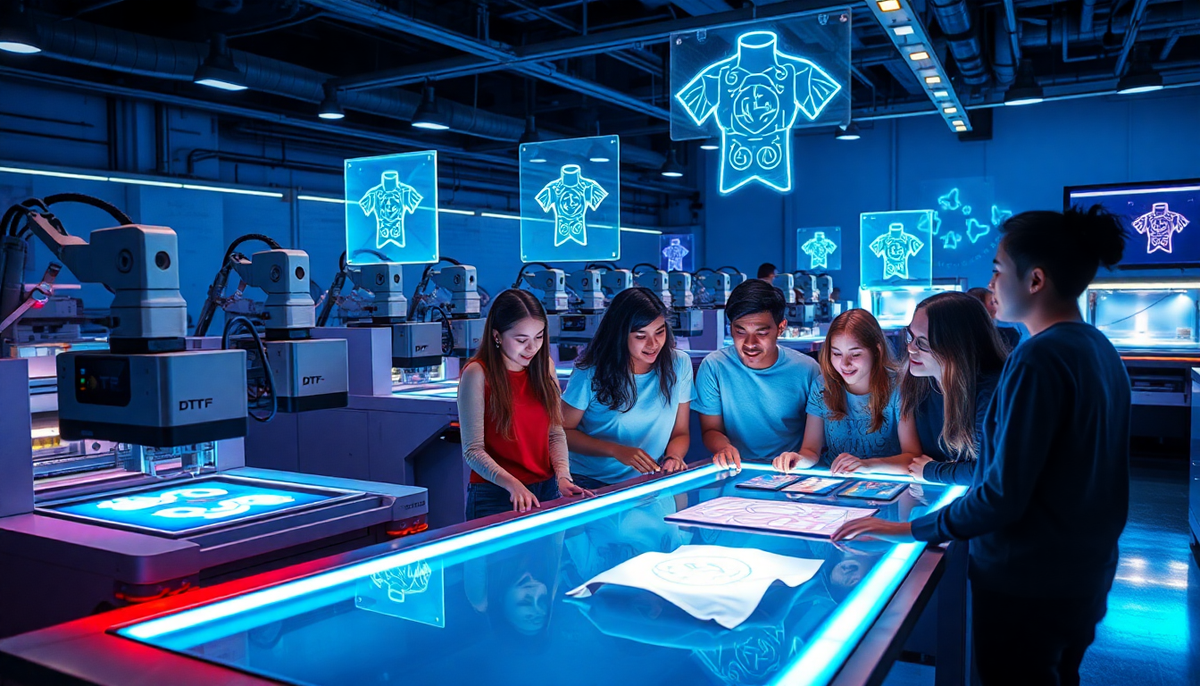
Understanding DTF Printing: The Future of Custom Apparel

Understanding DTF Printing: The Future of Custom Apparel

DTF (Direct to Film) printing has transformed the custom apparel industry in under five years. What started as a niche alternative to screen printing is now the fastest-growing garment decoration method worldwide. For businesses of all sizes — from single-operator home setups to large fulfillment...
By InkMerge · Nov 17, 2024 · 10 min read

DTF (Direct to Film) printing has transformed the custom apparel industry in under five years. What started as a niche alternative to screen printing is now the fastest-growing garment decoration method worldwide. For businesses of all sizes — from single-operator home setups to large fulfillment operations — DTF has become the default starting point for custom apparel production.

Why DTF Printing Emerged

The custom apparel market has shifted fundamentally. Consumers expect: fast turnaround (days, not weeks), unlimited colors without setup fees, photorealistic designs, small order minimums (sometimes 1 unit), and affordable pricing despite customization.

Traditional screen printing couldn't deliver this. Each color requires separate screens. Small orders are uneconomical. Setup takes hours. Color limitations exist. Lead times are long. Screen printing excels at volume production of identical designs (100+ units of one shirt), but fails at customization economy.

DTF emerged from inkjet printing technology: print full-color designs directly onto transfer film in minutes, apply transfers to any garment with a heat press, ship the same day. No screen setup. Unlimited colors. Single-unit minimum. Turnaround measured in hours.

This technology shift created an entirely new market: previously impossible products became viable. Personalized gifts, small-batch merchandise, print-on-demand business models, and custom apparel for niche communities all became economically feasible. The market response was explosive.

The DTF Technology Stack: How It Actually Works

Step 1: Design and File Preparation

The process begins with a digital design file (typically PNG, JPG, or PDF with resolution minimum 300 DPI). This design is placed into DTF-specific printing software (RIP software) which converts the design into the DTF printer's language.

Critical step: the RIP software divides the design into separate color layers — one layer for each ink color the DTF printer will use. Most DTF printers use CMYK (Cyan, Magenta, Yellow, Black) plus white ink, creating five separate layers.

Step 2: DTF Printing — The Core Technology

A DTF printer uses industrial inkjet print heads (similar to large-format inkjet printers) to spray liquid inks onto a special plastic carrier film (typically PET plastic, 0.3-0.5mm thickness).

Print sequence: The design is printed in multiple passes — first the white ink layer (which creates opacity and color vibrancy when applied to dark fabrics), then the CMYK color layers on top of the white. Modern DTF printers print at resolution up to 1440 DPI (pixels per inch), creating photorealistic detail.

Immediately after printing, while inks are still wet, the printer applies adhesive powder (specifically formulated polyurethane powder) to the wet ink. This powder clings to the wet ink surface, coating the entire design.

Step 3: Powder Curing

The carrier film passes through a heating chamber (typically 60-90°C) where the adhesive powder partially fuses with the ink layer. This creates a stable, transferable unit — the inks and adhesive are now bonded to the film and won't shift or separate during storage or handling.

This curing step is critical: insufficient curing means the transfer is unstable (adhesive powder flakes off). Over-curing means the adhesive bonds too firmly to the film and won't transfer to the garment effectively. Quality DTF printing requires precise curing control.

Step 4: Heat Press Application

The dried transfer (ink + adhesive on carrier film) is placed ink-side-down on the garment. A heat press applies controlled heat (typically 300-350°F) and pressure for 10-15 seconds.

Under heat, the polyurethane adhesive becomes tacky and penetrates the garment fabric fibers. The combination of heat, time, and pressure melds the transfer into the fabric. After cooling, the design is permanently bonded.

The carrier film is then peeled away, leaving the ink and adhesive bonded directly to the garment fabric.

Step 5: Finished Garment

The result is a permanent, washable design that's part of the fabric itself. Unlike heat transfer vinyl (which creates a raised, plasticky layer) or screen printing (which sits on top of the fabric), DTF transfers blend into the garment. The hand feel is soft, colors are bright, and adhesion is durable.

Key Advantages of DTF Over Traditional Methods

vs. Screen Printing

DTF advantages:

  • No screen setup required (no films, exposures, chemicals)
  • Unlimited colors without additional cost
  • Faster turnaround (minutes vs. hours)
  • Profitable at 1-unit minimums vs. 12-24 unit minimums for screen printing
  • No color separation complexity (software handles it automatically)
  • Works on any fabric type in any color (darks and lights equally well)

Screen printing advantages:

  • Slightly more durable on 100+ garment orders (minimal advantage in practice)
  • Lower cost per unit at extreme volumes (1000+ units of same design)
  • Better for thick, specialty inks (puff ink, glitter, metallic)

For modern custom apparel businesses, DTF replaces screen printing for most applications. Screen printing survives only in extreme high-volume scenarios (1000+ identical shirts).

vs. Heat Transfer Vinyl (HTV)

DTF advantages:

  • Photorealistic images possible (HTV is limited to spot colors)
  • Softer hand feel (HTV feels plasticky)
  • Better for fine detail and small text
  • Works on more fabric types (HTV works only on smooth, flat surfaces)
  • Lower material cost for complex designs

HTV advantages:

  • Better for solid color designs with heavy text emphasis
  • Can create 3D raised effects (puff vinyl)
  • Works on darker or more heavily textured fabrics without white underbase
  • Slightly faster application (press once vs. printing + pressing)

DTF is more versatile overall; HTV survives for specialty applications (heavy metallic effects, 3D puff designs).

vs. Direct-to-Garment (DTG) Printing

DTF advantages:

  • Works on light AND dark fabrics (DTG struggles with darks without light base)
  • Better color saturation and vibrancy
  • Lower equipment cost ($3,000-8,000 for complete DTF setup vs. $15,000-30,000 for DTG)
  • Faster printing (no on-garment pre-treatment needed)
  • Smaller footprint (no water/ink disposal complexity)

DTG advantages:

  • Softer hand feel on some fabrics (no adhesive layer)
  • Works directly on garment (no transfer film waste)
  • Slightly more permanent (no adhesive to degrade)

DTF has largely replaced DTG in modern production because cost, versatility, and color quality favor DTF.

The DTF Market and Industry Growth

Market Size and Growth Trajectory

The global DTF printing market was valued at approximately $400-500 million in 2022 and is projected to exceed $2 billion by 2027. This 30-40% annual growth rate reflects rapid adoption across multiple sectors: e-commerce custom apparel, corporate promotional products, in-house brand printing, fulfillment services, and niche merchandise.

This growth is driven by: declining equipment costs (DTF printers dropped from $50,000 in 2018 to $5,000-15,000 in 2024), increasing software maturity (RIP software and design tools becoming more user-friendly), and rising demand for customization (consumer preference for personalization over mass production).

Who's Adopting DTF and Why

E-commerce sellers: Entrepreneurs with print-on-demand Etsy shops or Shopify stores. DTF enables profitable single-unit orders with fast turnaround. These are the fastest-growing DTF user segment.

Corporate promotional product companies: Businesses handling corporate merchandise (company t-shirts, conference swag, employee gifts). DTF's flexibility and color accuracy make it ideal for complex branded designs.

Established apparel businesses: Screen printing shops expanding into custom work, embroidery shops adding print capability, or traditional garment decorators diversifying.

In-house printing operations: Larger brands (apparel companies, merchandise retailers) bringing print production in-house rather than outsourcing. DTF's automation and consistency appeal to operations-focused organizations.

Regional Adoption Patterns

DTF adoption is highest in North America and Europe, with rapid expansion in Asia-Pacific. Different regions prioritize different applications: North America favors small-batch custom apparel and e-commerce, Europe emphasizes sustainable production and premium personalization, Asia-Pacific focuses on volume production and cost optimization.

Current State and Limitations of DTF

What DTF Does Exceptionally Well

  • Full-color photorealistic designs: DTF excels at multi-color, gradient, and photographic designs. Color accuracy and detail are excellent.
  • Dark fabric printing: DTF's white ink layer enables bright colors on dark garments (black, navy, dark gray).
  • Small production runs: Single-unit orders are economical. DTF has no setup cost (no screens, no plates).
  • Fast turnaround: Print and apply in the same day. Some operations complete custom orders in 2-4 hours.
  • Cost efficiency at low volumes: DTF is cheaper than screen printing below 50-100 units.
  • Fabric versatility: Works on cotton, polyester, blends, and numerous specialty fabrics.

Current Limitations

Adhesive durability in washing: DTF transfers survive 50-100+ wash cycles, which is good but slightly less than screen printing (100+ cycles). This is acceptable for most applications but matters for ultra-durable workwear.

White ink consistency: Achieving perfectly uniform white underbase is challenging. Over-application creates stiffness; under-application creates color issues on darks. White ink management is the most common pain point in DTF operations.

Specialized ink effects: DTF doesn't do metallics, puffy/3D effects, or ultra-thick ink applications like screen printing. For specialty effects, other methods work better.

Hand feel on delicate fabrics: The adhesive layer adds slight stiffness, noticeable on lightweight fabrics (rayon, silk, thin polyester). Screen printing maintains softer hand feel on delicate items.

Design placement complexity: While DTF enables easy printing anywhere, some garment areas (seams, collars, sleeves) present pressure and adhesion challenges. Placement strategy matters.

The Economics of DTF Operations

Startup Cost Analysis

Minimal setup ($5,000-8,000):

  • DTF printer (entry-level): $5,000-7,000
  • Heat press (15x15): $500-800
  • RIP software: $500-1,500
  • Design software (Photoshop, Affinity): $500-1,000
  • Supplies and misc: $500-1,000

Complete professional setup ($15,000-25,000):

  • Quality DTF printer: $10,000-15,000
  • Commercial heat press (16x20, swing-away): $1,500-2,500
  • RIP and design software (full licenses): $1,000-2,000
  • Additional heat press (backup/volume): $1,000-2,000
  • Supplies, clothing racks, workspace setup: $1,500-2,500

Cost Per Transfer and Margin

Single-unit print-on-demand:

  • DTF transfer cost (all materials): $0.80-1.50
  • Blank t-shirt: $2-4
  • Heat press labor (2-3 min): $0.50-1.00
  • Packaging and shipping: $1-2
  • Total cost: $4.30-8.50
  • Retail price: $15-25
  • Profit per unit: $6.50-20.70 (44-71% margin)

Bulk order (100 units of same design):

  • DTF transfer cost (economies of scale): $0.40-0.70
  • Blank t-shirt (bulk pricing): $1.50-3.00
  • Heat press labor: $0.30-0.50
  • Packaging: $0.50-1.00
  • Total cost: $2.70-5.20
  • Wholesale price to customer: $8-12 (or retail $18-28)
  • Profit per unit: $2.80-9.30 if wholesale, $12.80-23.30 if direct retail

DTF profitability is exceptional at small-to-medium volumes (10-200 units). Margin decreases at extreme volumes (1000+) where screen printing becomes competitive.

The Future of DTF: What's Coming

Technological Improvements in Development

Better white ink formulations: Manufacturers are developing white inks that are more stable, easier to apply uniformly, and require less volume. Next-generation white inks will be a important for DTF consistency.

Larger format printers: Current DTF printers max out around A3 size (11x17 inches). Larger-format DTF printers enabling direct printing of oversized transfers or gang printing multiple designs would increase throughput significantly.

Integrated heat pressing: Prototype systems combine DTF printing and heat pressing into single machines. These still-experimental setups could eliminate the separate heat press step and dramatically increase production speed.

Improved adhesive chemistry: Research into adhesives that are softer (better hand feel), more durable, and work across more fabric types. Improved adhesive is a priority for multiple manufacturers.

Market Maturation and Consolidation

The DTF market has 100+ printer manufacturers, creating quality variation and consumer confusion. Expect consolidation: some manufacturers will exit, established brands will dominate, and quality standards will increase. This benefits consumers (better reliability, more support) but increases competition pressure on operators.

Expect supply chain maturation: consistent transfer quality, standardized RIP software, and interoperable equipment from different manufacturers. The current era of experimenting with different suppliers will give way to standardized best practices.

DTF Compared to Emerging Alternatives

Eco-Ink DTG

Some manufacturers are developing water-based DTG inks that are more sustainable than traditional DTG inks. These remain more expensive and produce softer hand feel than DTF but with sustainability marketing. Likely a niche offering rather than mainstream replacement for DTF.

DTF vs. Digital Print-and-Cut

Hybrid systems combining digital printing with automated cutting for heat transfer vinyl application are emerging. These offer benefits of both modalities but require more labor and post-processing than DTF.

Laser Direct Transfer

Early-stage technology using lasers to transfer designs directly to garments. Still experimental and far from commercial viability, but represents potential future disruption to DTF's dominance.

FAQ: Understanding DTF Printing

Is DTF printing environmentally friendly?

DTF uses less water than DTG or screen printing (no wash water), generates less chemical waste, and has lower emissions than some alternatives. But it's not "green" — it uses synthetic inks and polyurethane adhesives. As a technology, DTF is reasonably sustainable; the industry continues improving environmental practices.

Can I start a DTF business with minimal investment?

Yes. A basic setup (entry-level printer + heat press + software) costs $5,000-7,000. This is lower than almost any other custom apparel method. Profitability begins immediately with high-margin print-on-demand orders.

Is DTF a saturated market?

Competitive, but not saturated. The market is growing fast enough that new entrants can build profitable niches. Success depends on: service quality, customer focus, design skills, and marketing — not on being first.

Can DTF replace screen printing entirely?

For most applications, yes. For extreme high-volume (1000+ identical units) or specialty effects (puff ink, metallics), screen printing survives. But for custom apparel and small-to-medium runs, DTF is superior.

What's the skill level required to operate DTF equipment?

Moderate. Learning the specific heat press settings for your equipment and fabrics takes practice (20-50 test presses). Understanding RIP software and file preparation takes familiarity. Design skills are separate from equipment operation. Most people can learn competent DTF operation in a few weeks of practice.

Is DTF quality consistent between different manufacturers?

Variable. Established manufacturers (Epson, Ricoh, Mutoh-based systems) produce consistent results. Newer or Chinese manufacturers have higher quality variance. Choose established brands for reliability.

Conclusion: DTF as the Modern Standard

DTF printing has become the default technology for custom apparel production because it solves fundamental economic and quality problems that other methods couldn't address. The technology is mature, cost-effective, and accessible to businesses of any size.

For entrepreneurs considering custom apparel, DTF is the obvious starting point. For established businesses, DTF expansion is the most cost-effective way to increase capability and reach new markets. The technology will continue evolving, but DTF's fundamental advantages are durable — expect it to remain dominant for at least a decade.

Related Reading: DTF White Underbase Explained, Best Resolution for DTF Transfers: DPI and File Format Guide, and T-Shirt Printing Methods Explained.

Next Article